Rodehuser Panta
Rodehuser Panta
When I built my vintage camera database, I harvested information from any available source and sieved it for duplications and errors. Having said that, all was done manually. The result is a list of just under 28,000 models, which is user-searchable at camdex.ca. The downside is that much of the information is derived from cameras offered for sale/sold on any available channel, as well as online and print data. Online descriptions and naming conventions are correct in most cases, but when the seller is not versed in this trade, the camera is given a creative name for a non-existent model, which I have recorded. Examples are the Zeiss cameras offered as Zeiss + shutter name rather than by Zeiss catalogue number. Further, different camera guides in print do not always use the same naming conventions, so when all are collected, the list mushrooms, and it takes closer attention to see what is what. I do that when I look into a specific model or brand, which is done on this site.
The Dr. Rodehuser Panta models are a good example of the above. When I first looked at it, my list held eight models, all collected from actual sources. In reality, there are only two models, named by the factory as Panta 4.5×6 and Panta 6×6. At the same time, the very same models were named at some guides as Panta I and Panta II. For good measure, one camera was sold on eBay as Panta 5×5, and three variants are listed online as Ia, Ia, IIb, IIIb, all of which I dutifully listed. These models are mere production variants, with different lenses or shutters, as dictated by the frail supply chain of the time.
So, from a list of eight Panta models, I am down to two. The same is correct for most any other camera make I have looked at.
The camera was made under several manufacturing incarnations, which is the focus of most online articles, a kind of schadenfreude. Apparently, the founder, Dr. Rodehuser, was sold on the idea of camera-making after the war, when the German consumer market woke up. As a side note, it is said that the Doctor was a physician, which I suspect is a later interpretation, as if so, he would have been gone by Dr. Med., which was the correct title. Just a Dr. at the time could be obtained by three years at law school, as Dr. Jur., short for Doctor juris. Most, if not all, camera makers with the Dr. titles were law school graduates.
Note that the name is also spelled Rodehueser, as a substitute for the Umlaut.
Dr. Rodehuser offered his first model in 1950, but, as with many other German post-war camera makers, good intentions and high hopes were not a guarantee of commercial success. When the company failed financially, he dropped it and fled to Brazil, from where there are different views: either he returned or stayed there. Here came a twist: an associate, Dr. Heinrich Otterbach, established another company with a similar name and fraudulently secured government development funding of DM 750,000 (about USD 2.5 million at today’s rate), for which he ended up in jail. It did not end there; a group of investors, led by the village butcher, a certain Mr. Schuck, took over the factory in a third incarnation. As such, the company could be found under the following names:
- Rodehuser, Feinmechanischer Optischer Geratebau.
- Westfalische Kamera und Apparatebau.
- Feinmechanisch-optischer Geratebau Schuck & Co.
The best information about it is a 2013 Photo Deal article, which seems to be the source for other online pages. Google Translate may come in handy.
After all is said and done, the cameras are quite nice. There were two models, similar to each other:
- Panta 4.5×6 of 1950, using the #127 format for 4.5x5cm images, of which about 3,000 were sold.
- Panta 6×6 of 1952, using #120 format for 5×5.5 cm images, about 10,000 sold.
As stated above, there were variants using different lens and shutter combinations, per supply chain constraints of the time. The company was at the bottom of the food chain, far beyond the major camera makers, so they had to make do with whatever they could get. Some guides list these variants, but as they were all sold under the same model’s name, I did not list them.
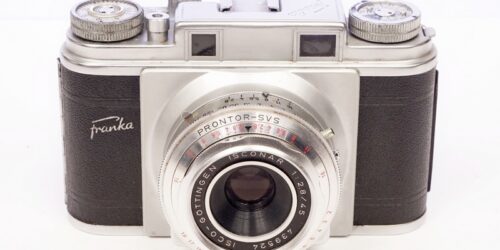
- The body is made of aluminum casting, nicely satin finished. It is relatively lightweight compared to compatible era cameras.
- Top has a screwed-on viewer combined with a cold accessory shoe. A tiny viewer, as was on most cameras of the time. A knob at each side, one winder and the other aptly marked ‘open’ in English and German, that pops off the back cover.
- The fully removable back cover is connected via two springy catches. To mount back, just align it with the body and press it in. A pressure plate and a red lens, covered by a slider, are on the back cover.
- The retractable lens assembly comes forward with a pull and locks in place with a slight right turn. A body-mounted pin at seven o’clock secures the assembly in place once it is retracted and stops the trigger from firing.
- The markings on the lens dials are of a good size and are easy to read. Closest to the body is the aperture selector fin; you may need to search for it. Next, on top, is the shutter cocking lever, with the trigger at eight o’clock and the self-timer lever at five o’clock, which I do not activate, as this fails first and spoils all fun. Flush with it is the shutter speed dial, and at the front is the zone focusing dial, marked in meters. Note that this refers to the camera on my bench, and the variants may have different shutter and lens features.
- I do not have the 4.5×6 model, but from what I read and see online, other than the body size, they are the same.
The camera is straightforward to use, with no fancy or mysterious levers or dials. For the collector, it is a nice-to-have model, made in a short run and with a checkered past. They are not readily offered for sale, so I would recommend grabbing one when it is offered.
| Camdex list number | 27134 |
| Brand | Rodehuser |
| Model | Panta 6×6 |
| Manual | |
| Value | Panta 6×6 Panta 4.5×6 |
| Format | 120 |
| Introduced | 1952 |
| AKA | Schuck Bergkamren |
| Country | Germany |
| Qty made | About 10,000 |
| Initial price | 93 |
| Currency | DM |
| Type | Viewfinder |
| Body material | Metal |
| Mode | Manual |
| Weight | 510 gr, Body with lens |
| Class average weight | 475 gr, Body with lens |
| ASA range | N/A |
| Kit lens | 3.5/75 |
| Lens make | Ennar |
| Filter size | N/A |
| Lens mount | Retractable |
| Mount size | N/A |
| Aperture | |
| Shutter | Leaf |
| Shutter make | Pronto |
| Trigger | On the lens barrel |
| Winder | Lever |
| Shutter cocking | Lever on lens barrel |
| Light meter | None |
| Lock | No |
| Speeds | B, 25-200 |
| Mirror | N/A |
| Viewer | Viewfinder |
| DOF preview | No |
| Exposure lock | No |
| Exposure compensation | No |
| Shoe | Cold |
| External sync | X |
| Sync speed | N/A |
| Timer | Yes, mechanical |
| Battery, original | N/A |
| Battery, replacement | N/A |
| Battery voltage | N/A |
| Integral flash | None |
| Other | |
| More | 2013 Photo Deal article |
| Service / repair links | See camerlog.com |
| Note that the specs above are taken from the camera on my bench. Cameras under the same model could have different lenses or shutter assemblies, or other minor differences. |